Design Thinking Reflections
Last week, SAP invited me to Orlando for their SapphireNOW annual conference. I’ve been to the US many times and attended plenty of big corporate conferences — travel, meetings, shopping — nothing特别 memorable. The only thing that felt genuinely rewarding was participating in a Design Thinking Jam organized by the SAP University Alliance before the main event, giving me hands-on experience with the methodology.
Design Thinking is a group thinking methodology. It provides guidelines for groups discussing specific problems — how to think more effectively. It divides the thinking process into several stages, each with key points to consider. I won’t go into details; see the Wikipedia link.
I first heard about Design Thinking a few months ago from Audi. Audi had a lab at Tongji and wanted to run a workshop, gathering creative students to design mobile car software for the Chinese market. They contacted me because they wanted to invite students from the Software School’s Apple Club. They mentioned using Design Thinking. The German Audi guys had been in China long enough to understand local characteristics — knowing Chinese only respect top universities, they claimed the method was invented by Stanford to impress us. I later checked — it’s vaguely connected to Stanford, but calling it a Stanford invention is an exaggeration.
SAP places great importance on Design Thinking. Their Co-CEO mentioned in keynotes multiple times that they use Design Thinking to design SAP software. At the Sapphire conference, they even set up a dedicated Design Thinking zone with a glass room where people were solving problems live using the method. Clearly, the company takes it seriously. Naturally, the University Alliance follows suit, closely aligned around leadership, promoting Design Thinking among students. So a day before the conference, they gathered students and teachers from around the world to灌输 the method first.
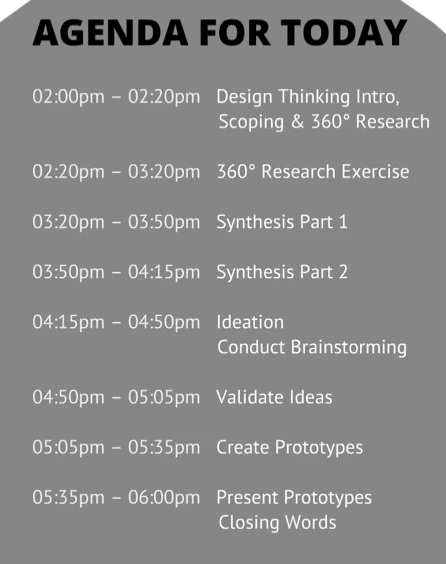
The Design Thinking Jam was scheduled for the afternoon — a tight schedule from introduction to project completion in just a few hours. Since it was my first day in the US with a 12-hour jet lag, I was seriously struggling after 2 PM.
Participants included students from the US, Germany, India, China, and some other countries I couldn’t identify. They randomly assigned people into 6 groups, each with diverse educational and social backgrounds. My group had 7 people: an American professor, a German professor, me, a German student, and three Chinese students. Each group got a topic from SAP’s recent competitions. One topic was smart cars — I was genuinely interested, as it relates to my research. But my group got: “How to use new energy to change human life.” I knew nothing about this. Which was fine — it would test whether this methodology actually works.
Design Thinking has these stages: Scoping, Research, Synthesis, Ideation, Prototype, and Validation. The Jam format: each stage starts with a ~15 minute introduction, then hands-on work on your topic, also timed. Let me briefly explain each.
Scoping: Define what you will and won’t do. Similar to requirements analysis. DT mainly solves ill-defined problems — a blob of ambiguity — so first定位 the problem itself.
Research: Investigate customers. What do customers want?
Synthesis: Based on research, generate用例-like stories.
Ideation: Brainstorming. Discuss how to turn the stories into reality.
Prototype: Build a展示 prototype — not necessarily code; UI sketches on paper work.
Validation: Evaluate the prototype’s problems, then improve.
I won’t detail every step or this becomes a流水账. A few impressions worth mentioning.
First, scoping. Our topic was just one sentence: “How to make new energy, especially water resources, change human life.” Initially, our group interpreted this as designing a new energy source. We panicked — we know nothing about new energy, and now we’re supposed to design it? Ridiculous. After several rounds of discussion, we all agreed that IT people shouldn’t搞 new energy. Better to figure out how to use IT to help improve water resources. Still on topic. As for designing new water resources — let’s not go there. This made our scope much clearer.
Some guiding principles were useful. For example: don’t rush to think about implementation. This is a common mistake. I saw a neighboring group getting very excited — when I passed by during the first two stages to get coffee, they already had system architecture diagrams. Clearly a group of coders who, the moment they see a problem, want to start writing code.
Another one: during ideation, don’t evaluate ideas prematurely, or you’ll stifle creativity. Our group had a Chinese girl with mediocre English who liked to talk. She raised an irrelevant question, speaking very, very slowly. I couldn’t take it — time was running out — and said: “You’re off-topic, don’t waste time.” The German guy immediately said we should let her speak — “Don’t rush to evaluate ideas, otherwise no one will dare to提出 ideas.”
Below is our group’s two cases for storytelling. We proposed a mobile water quality monitoring device that connects to phones,检测 water quality anywhere, and uploads to the internet for sharing. Others can see water quality in different areas and take protective measures in advance. This system could also be used by water companies to monitor and improve water quality.

Figure: Two storytelling cases.
An interesting side note: Chinese people are traditionally reserved and don’t speak up. Our group had several Chinese members, but combined they said less than any single foreigner. To not embarrass the Chinese, I started talking a lot. Later, the American professor pulled me aside during tea and said: “This is for students — let’s not interfere too much. Just spectate, or it’ll become a class exercise again.” He had a point. So I went back and we both switched to jokester mode. When asked to draw use cases, he said: “No, I teach neural networks and genetic algorithms — I can do that, but I can’t draw.” I immediately chimed in: “Me too, I teach the same stuff and can’t draw either. Give me five!” The German guy in our group couldn’t stand it — seeing the students underperform, he eventually pushed the students aside and presented himself. He did well, at least middle-of-the-pack among the groups.
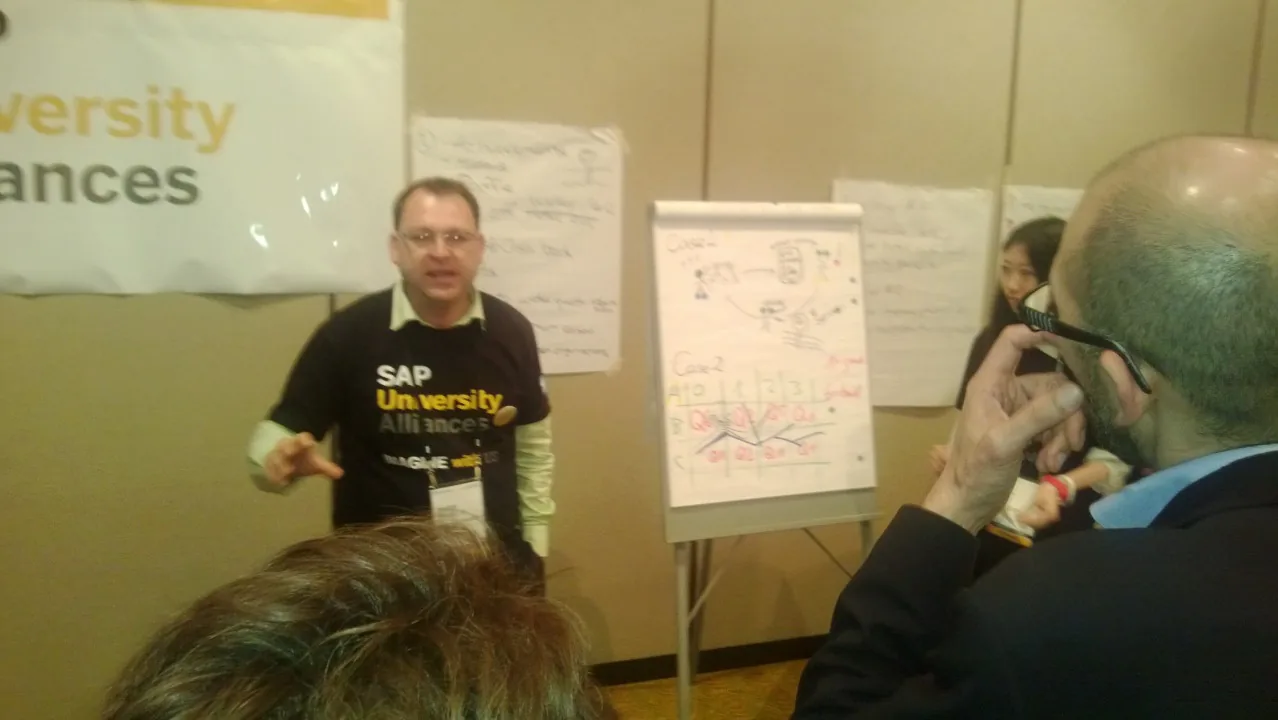
Figure: Five-minute presentation
Other reflections:
First, foreigners seem to really enjoy studying this kind of innovation methodology — how to use your brain to come up with new ideas. In academia, I’ve encountered many foreigners promoting thinking methodologies. Earlier, a group of Brits came to promote TRIZ, and we even hosted a TRIZ workshop. No wonder — China’s traditional education gives you a problem and you solve it. Often there’s a standard answer — no innovation required. This was evident at the Jam. Chinese and Indian students were the “good students” — when told what to do via slides, they immediately started following Design Thinking steps. A white guy in a neighboring group kept arguing with the instructor: “This method isn’t reliable. If I do this, here are the bad consequences.” THAT’s thinking out of the box.
Second, Chinese students and teachers still have weak international communication skills. In a mixed group of multiple nationalities, Chinese were undoubtedly at the bottom. SAP had told us beforehand to actively participate and bring honor to the country. But several professors from other Chinese schools stayed completely silent throughout. There was also a Chinese student in my group who didn’t say a word — even when asked directly. This can’t be separated from China’s education system. We learn English from elementary school through university, and still end up like this.