Why Marriage Is Treated as a Game
Originally, the title was “Why Chinese People Treat Marriage as a Game.” But since the comparison is with Hong Kong — and while half of Hong Kongers don’t consider themselves Chinese, I can’t make a political mistake — “mainland Chinese” is more appropriate. Hong Kong, Taiwan, and Macau are excluded.
In recent years, China’s divorce rate has been rising, with all kinds of bizarre divorce reasons appearing in the media. Some divorce to get an extra housing allocation, some to buy a house, some to sell a house, some to get land, some to have more children, some to go abroad more easily… Some even fake-divorce their wife and then marry their mother-in-law. As long as marriage becomes an obstacle to achieving something else, or divorce offers some benefit, they won’t hesitate. It seems marriage has become the most worthless thing, something to be traded for any small favor.
This seems to be unique to the mainland. In my years in Hong Kong, I often read trashy tabloids like Sharp Daily and Apple Daily, but I never saw Hong Kong people following the mainland’s example. Thinking deeper — why is this? I think it’s partly about the law and partly about mindset. But the key is the law.
Regarding the law — the barrier to marriage and divorce is too low. Under mainland marriage law, in theory, you can get married and divorced countless times in a single day. The only limit is the civil affairs office’s工作效率. And the cost is minimal — a few RMB for a marriage or divorce certificate. This leads to countless cases of flash marriages and divorces. Want to buy a house? Divorce your wife in the morning, buy the house at noon, and remarry in the afternoon once the paperwork is done. Totally feasible. Or you have a fight with your spouse, and in a fit of anger, immediately cab it to the civil affairs bureau. Let’s look at how Hong Kong law handles this:
Unless approved by the court, a divorce petition cannot be filed until at least one year after marriage.
- Before filing a divorce petition, the petitioner and spouse must have lived apart for at least one continuous year, and the spouse must consent to the divorce.
- Before filing a divorce petition, the petitioner and spouse must have lived apart for at least two continuous years. (In this case, the spouse’s consent is not required.)
i) Divorce decree — from scheduling to hearing
- Undefended cases: 50 days
- Defended cases (all hearings): 110 days
ii) Financial applications — from scheduling to hearing (hearing lasting 1 day): 110-140 days
Case type fees:
- Undefended cases: $630
- Defended cases: $1,045
Increase the cost of divorce across multiple dimensions — time, money, conditions. Time: you must be separated for at least a year before divorcing, with evidence like utility bills at separate addresses — not just colluding. Then queue up: fastest 50 days, slowest 110 days. Pay fees of $630 to $1,000+. If you need a lawyer, that’s 100,000 HKD minimum. Artificially raising the cost of divorce means those who truly need a divorce will still get one. But those wanting to buy a house or get land? Forget about flash divorces — unless you’re playing some long game.
And remarrying isn’t simple either — it involves booking, registration, tax refunds and adjustments (Hong Kong taxes individuals by household), surname changes for women (damn capitalism — in China, women not only keep their surname but fight to put their name on the property deed), and a series of procedures. It makes you truly realize marriage isn’t a joke.
Another thing Hong Kong does well is how they record marital status. In mainland China, every form gives you two options: married or unmarried. Get married → married. Get divorced → unmarried. Hong Kong is different: their forms have four options — unmarried, married, divorced, widowed. Think about this — it’s brilliant. “Unmarried” is a state you can only be in once in your life. Once you leave it, you can never go back. Last semester I studied stochastic processes, so I drew two state diagrams — it’s一目了然.
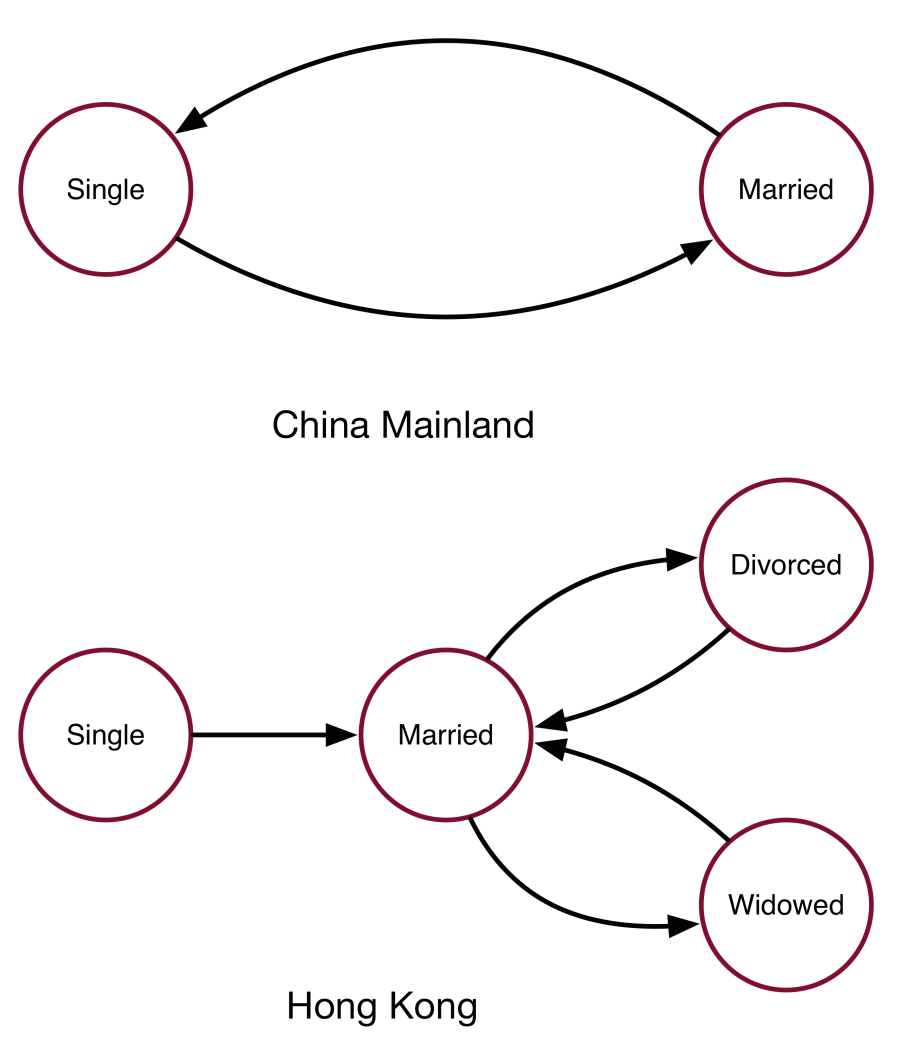
Mainland China’s model is simple: two states, switch back and forth. Hong Kong’s is different: everyone starts unmarried. Once you get married, you become “married,” and you can never go back. If divorced, you become “divorced.” If you remarry, back to “married.” If your spouse dies, you become “widowed.” If you remarry, back to “married.” In rigorous mathematical terms, “single” is a null recurrent state. The formal definition:

In plain language: once you leave the “unmarried” state, no matter what you do, you can never return to being single. This gives unmarried people an important lesson: marriage is risky, registration requires caution. Don’t get hot-headed and steal the family户口簿 to register with someone while your parents are away.
Another difference: the certificate the mainland civil affairs bureau issues is called a “singlehood certificate,” covering unmarried, widowed, and divorced — all look the same, indistinguishable. In Hong Kong, they issue a “no marriage record certificate,” similar to a “no criminal record certificate.” If you’ve ever been married (committed a crime), this certificate is forever out of reach.
So sometimes, relying on quality and morals alone doesn’t help. You need the rule of law — strictly enforced rule of law.