Qian's Education Journey #2
Preface
September 2015, Shanghai. About a month after Qian started primary school. The reception room of his school.
“You’re the parent — you need to take responsibility for your child’s education! Every day, the teacher only spends 6 hours with the child. The remaining three-quarters of the time, the child is with the parents. Family education is more important than school education! You’re a teacher yourself — you should understand this! If he falls behind now, he’ll be learning characters soon, reading in Year 2, and writing essays in Year 3. Can he keep up?!”
The Chinese teacher’s barrage of questions left me no room to respond. Qian stood frozen, his face pale, barely daring to breathe. I’d turned down several colleagues’ and friends’ advice to enrol Qian in a “pre-primary bridging class.” After school started, they moved through pinyin so quickly that Qian couldn’t keep up. Less than a month into school, they called the parents. That was my only meeting with Qian’s teacher in China.
Now, Qian had been at his New Zealand school for just over a month. Once again, I was on my way to meet the teacher. And with Qian’s language issues, he was definitely struggling. My heart was in my throat. I braced myself for another scolding.
Parent-Teacher Meeting
When I arrived at the school, I found the meeting location — not a classroom. I peered in. Glasses were clinking inside. I thought I’d gone to the wrong place. I asked softly, and the teachers said, “No, you’re in the right place. Come in. Grab something to eat and drink first.” And so this photo was taken.
When I met the teacher, I started criticising myself: “Qian hasn’t been here long, his English isn’t good. He probably can’t understand what’s going on in class, and when you give instructions, he might not know what to do…” Several teachers chimed in: “Don’t worry, kids learn fast. Now, let’s get to the main topic. This term, we have three activities: a barbecue, a beekeeping observation, and a cross-country run…” I took careful notes. After covering the activities, the meeting ended. I was bewildered. What about academics? Why didn’t we talk about learning at all?
I later learned there are three types of parent-teacher meetings in NZ. The first is the PTA (Parent-Teacher Association), usually consisting of teachers and enthusiastic parents. It focuses on extracurricular activities and fundraising. No academic discussion. Very relaxed. The first meeting I attended was this type. Attendance is entirely voluntary. I never heard of the Chinese phenomenon where parents are forced to showcase talents. I only went once and never returned. But they still email me the minutes — usually about organising events and fundraising to upgrade classrooms or buy new equipment.
The second type is at the start of each school year, introducing what will be covered. Similar to China — not much to say. The third type is one-on-one, usually mid-year. The teacher sets aside half an hour to chat with each child’s parents. They have a website for scheduling.
When we met one-on-one with Qian’s teacher, his English was already decent. But he didn’t like studying much. We wanted the teacher to discipline him, put some pressure on him. So we told the teacher: “Our son just plays when he gets home. He won’t study no matter what we say. Teacher, don’t you think he needs a talking-to? He’ll listen to you…”
“He’s been in school all day. He’s tired. He needs to rest when he gets home. Don’t forget, he goes to school five days in a row!”
I was stunned. This was the complete opposite of what Chinese teachers say. How can a teacher say students need rest?
I thought the teacher misunderstood. I rephrased: “I think his English still isn’t good enough. Is there any tutoring or intensive class he could attend after school?” The teacher suggested, “Let him play more with other kids. He’ll learn English through play.” That didn’t sound convincing. I pressed about tutoring. The teacher said, “If you really want to enrol him in something, let him learn swimming. He’ll expand his vocabulary through swimming — words like ‘kick’ and ‘blow bubbles’…”
English Learning
Anyone moving far from home probably faces the language barrier first. I might be weak at languages. After 13 years in Shanghai, I still couldn’t understand Shanghainese. After 4 years studying in Hong Kong, I couldn’t understand Cantonese. But I’d always heard that children’s language abilities are strong — they adapt quickly and soon become native speakers. Is that true? I think it depends on the individual.
In Qian’s case, he’s been in New Zealand for just over a year. This is roughly how it went. When he first arrived, he’d learned some English in China but never attended any tutoring. His English repertoire was the “Lei Jun Triple” — “Hello, thank you, thank you very much” — in the Chinglish style learned at Chinese schools: “sank you wery much.” He couldn’t communicate with anyone at first. The school transferred a Chinese-born student who could speak some Chinese to be his translator. But that kid was already quite Westernised — Qian said his Chinese was sometimes hard to understand, and he didn’t really like playing with Chinese kids.
The school arranged twice-weekly English enrichment classes. Only two students: Qian and a Korean kid. The teacher only spoke English, starting with picture-word recognition, then progressing to simple books. Probably similar to VIPKID in China. Plus memorising words from the Essential Spell List — about 400 words. That was the only vocabulary he needed to memorise. Very different from the Chinese approach of “learning English means memorising vocabulary.” Mastering those 400 words in different contexts can handle about 75% of daily communication (according to the list). Don’t underestimate “mastering” — it’s not easy. I’ll write more about this later.
After about three months, he told me he could basically understand the teacher’s instructions and knew what everyone was doing. After about six months, a new Chinese student and a Japanese student who could speak Chinese joined the class. Qian became the translator for simple teacher instructions. By the end of the first year, he said he could understand 80% of everyday conversations and slightly more than half of the teacher’s lessons. His goal: to be indistinguishable from classmates by the time he finishes primary school.
For Qian, I feel he’s progressed very quickly. I’m already learning English from him. He corrects my pronunciation and teaches me common colloquial phrases — how to say “taking attendance,” “standing in the corner,” “tattling” — things you’d never learn from textbooks. I learned all these from Qian.
But some kids I’ve met haven’t been so fortunate with English. For instance, one friend of Qian’s was a “Two-Bar Squad Leader” back in China — Qian was a “One-Bar Squad Leader” (Chinese school rank system). After arriving here, they maintained their Chinese bureaucratic hierarchy — the two-bar leader supervised the one-bar leader, who supervised the commoners. They played together but this kid didn’t like interacting with non-Chinese children. When Qian threw a party and invited both the two-bar leader and some foreign kids, the two-bar leader overheard them speaking English and got upset. Didn’t speak a word of English the whole time.
Then there’s a Chinese family living nearby. Their two NZ-born kids were raised by their Shanghai grandmother. The elder just started primary school. He speaks perfect Shanghainese and when he visits us, he jokes in the voice of Bear Two from the cartoon: “We’re Auckland folks!” But I suspect his English might be worse than Chinese kids his age in China. And it’s not just Chinese parents — even mixed-race families struggle. We once saw a blonde, blue-eyed kid in the supermarket, rolling on the floor, shouting in perfect Mandarin: “Granny! I want a toy!” His Chinese grandmother was pleading, “Oh, my little ancestor, get up, I’ll buy it.” That’s cultural export for you.
Of course, some kids arrive too early — or are born here — and have perfect English but struggle with Chinese. That’s why there are Chinese language schools. Every time I pass this sign, I find the phrase “for non-speaking people” a bit odd. It seems Chinese is genuinely harder to learn. Or maybe it’s about environment. Learning Chinese in NZ is like learning English in China — no environment, just to satisfy parents or pass exams. After decades, you still won’t be fluent.

Tutoring Classes
In China, tutoring businesses like New Oriental and TAL Education are booming. Both are listed on NASDAQ, their stock prices multiplied countless times. Proof of the power of tutoring — and it’s bound to grow even more. Compared to Hong Kong and Taiwan’s “tutoring kings and queens,” China still has a way to go. So buying stock in New Oriental or TAL Education is probably wise.
One of Qian’s classmates who also came from China was already at reading level 10+ when he arrived — way ahead of Qian’s level 1. I later learned his family spent 50,000–60,000 RMB annually on tutoring in China. So the tutoring does work. Keep throwing money at it!
We never enrolled Qian in any tutoring in China. But here, since he was struggling, we looked around for classes. Swimming, clay sculpting — those aside — we’ve signed him up for two things so far.
One is an after-school care program. In NZ, leaving a child under 14 alone at home is illegal — worst case, you could lose custody. After-school care runs from 3:30 to 6 PM, $17 a day. But it’s just care — watching the kids. When I pick Qian up after work, he’s either lying on the floor, playing ball, or doing some activity. No learning involved. I’ve never seen anyone studying there.
The other is a tutoring class — maths and writing. Once a week, 1.5 hours, $55 each time. But the maths was too easy for him, and the writing too hard. After about two months, he refused to go. Hard to find something that fits.
Assessments
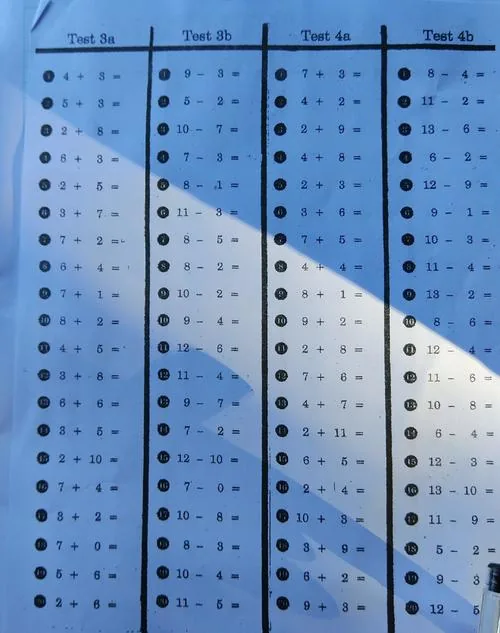
New Zealand primary schools have no exams. Homework is assigned weekly, not daily — given on Monday, due on Friday. A week’s work equals about a day’s in China. For maths, Year 1’s task is counting from 1 to 10. Qian is in Year 5 and still doing addition and subtraction within 20 — basically Chinese preschool level. China is all about pumping adrenaline; New Zealand is all about bleeding out.
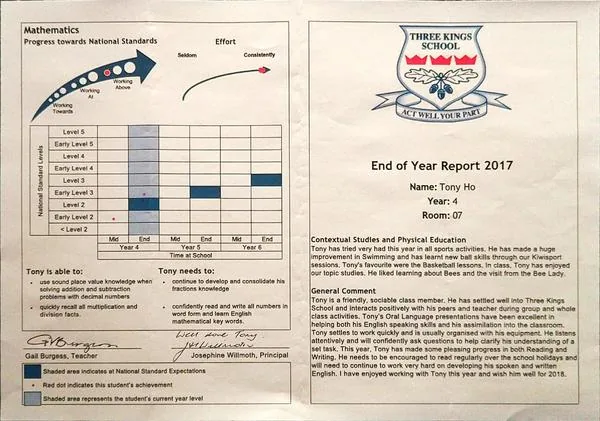
Although there are no exams, there’s an annual report based on the teacher’s subjective assessment. It’s mailed home. Results are not compared with other students — no ranking. Just compared to a standard: above, at, or below. For example, Qian’s maths was below standard when he first arrived — he couldn’t read the word problems and got everything wrong. By year-end, he was above standard. Besides maths, they assess reading and writing. So there are only three assessment categories: writing, reading, and maths.
In addition, the teacher writes a general evaluation. Qian’s started: “Qian has worked very hard in all sports this year, especially showing marked improvement in swimming and ball games…” I wondered if he’d enrolled in a sports school.
Afterword
That’s a lot of writing. In closing, I want to emphasise: this isn’t to say NZ education is great, and I’ve tried not to compare with China. The only thing I’m certain of is that Chinese and NZ education are different — after all, the national conditions are vastly different. Which is better? Hard to say. Maybe finding what suits you is the best.