Improving English as a Middle-Aged Person #2
English listening and speaking are the weak points for most Chinese, whether in exams or real life. Unlike vocabulary, which I covered in my previous article, these two skills require practice. When it comes to practice, Chinese people have a bad habit: they stick together. Building Chinatowns all over the world to seal themselves off — just like the foreign concessions in China. I’ve heard that in some US Chinatowns, people are born, live, and die without ever leaving those two streets — and without ever learning English. In Auckland, you can hear Chinese everywhere. On the University of Auckland campus, you often see groups of Chinese-speaking students. Rumor has it that at the business school — which has the most Chinese students — Mandarin has surpassed English as the first language, and WeChat has become the main social app. Put positively, it shows our cultural confidence and resistance to assimilation. Negatively, it’s insularity. The campus notice board often has Chinese posters too — but I’ve never seen a poster in any other non-English language. I don’t know if that’s a good thing.
When I first started working, I went with an American colleague to meet an Indian-origin researcher. This Indian guy talked nonstop — a torrent of words — but I barely understood a thing and couldn’t get a word in. I thought my listening was terrible. After chatting for a while, we left. As soon as we stepped out, the American said, “He must have been speaking Greek!” (In English, “Greek” means incomprehensible, like Chinese “Martian language.”) I felt instantly relieved — so his English wasn’t just hard for me, it was hard for Americans too. But then I thought: this kind of confidence is exactly what many Chinese lack. Most Chinese, feeling their English isn’t good, avoid speaking and stay silent. But this guy, despite his poor English, was utterly fluent and confident. It’s no wonder Silicon Valley Chinese coders don’t fare as well as Indian coders — and I suspect the same applies in New Zealand. Though we might be better at property speculation.
Listening and speaking are closely related. Usually, if your spoken English is poor, even simple sentences sound different from standard pronunciation, so you can’t understand standard speech when others speak it. Why is spoken English poor? Based on my improvements over the past year, the main issues are: incorrect pronunciation and connected speech. Just fixing these a bit will make your speech much more understandable — and it’s easier than memorising vocabulary.
Incorrect Pronunciation
When we start learning a foreign language, we unconsciously map the foreign sounds onto our native language. Like this picture:
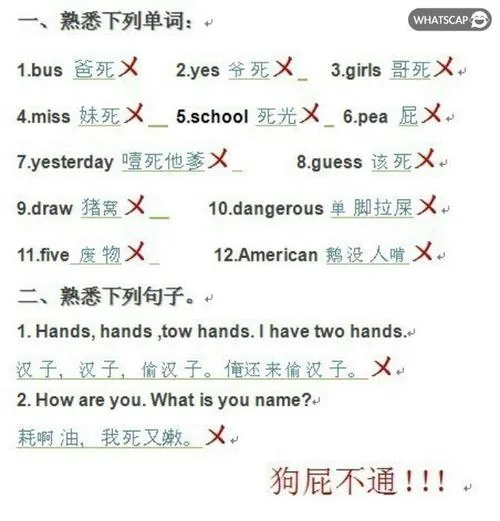
It’s not just us — Westerners do it too. Here’s how they learn Chinese:

Different languages have different phonetic features. Few languages have a perfect one-to-one correspondence in pronunciation. Forcing the mapping onto your native language causes inaccurate pronunciation. This mapping isn’t always intentional — it can happen unconsciously.
Let’s start with Westerners’ difficulties. What challenges do they face learning Chinese? English has no tones. So when we hear Westerners speaking Chinese, everything is in a monotone. If a foreigner studying Chinese can distinguish “ma,” “ma,” “ma,” “ma” (the four tones), I’ll compliment them on their Chinese. Similarly, English has no “xi” sound — they can’t distinguish between “xiao” and “shao.” So when you hear them say “President Xi” on the news, it sounds like “President She” — as if China’s leader is a woman.
Many English sounds also don’t exist in Chinese. So when we map them onto Chinese, no matter how we try, it’s not standard. Every Chinese character is a consonant + vowel (or just a vowel). Never just a consonant. But English has many words with consonants not paired with vowels. Take the handsome football star Beckham: the “k” and “m” have no vowel pair. How do you pronounce it? Mainland China and Hong Kong use different strategies. Mainland China adds a vowel to each consonant — “Bei-ke-han-mu” — forcing “k” into “ke” and “m” into “mu.” Hong Kong drops the consonant if there’s no vowel — translating it as “Bik-ham” (Cantonese pronunciation), dropping both “k” and “m.” Neither pronunciation is standard. Whether you say “Beikehanmu” or “Bikham” to a foreigner, they probably won’t know who you’re talking about.
Similarly, Chinese doesn’t distinguish between “v” and “w.” The character “wen” (culture) has two pronunciations. When Xi Jinping talks about “cultural confidence,” his pronunciation sounds more like the lip-biting “v” sound — “ven.” But when the news anchor says it, it’s the rounded “w” sound — “wen.” Since Chinese doesn’t distinguish these, no ambiguity arises. But if English doesn’t distinguish “v” and “w,” you end up with completely different words — like “vine” and “wine.”
When I first arrived, I had the same problem. Many sounds were inaccurate. Especially after Qian corrected me — I discovered even my pronunciation of the simple letter “A” was wrong, and I never knew. Try these pairs — can you distinguish them?
- war / wall
- thing / thin
- thank / sank
- wine / vine
- seek / sick / sake
- bat / bet
- cut / cart
I don’t want to turn this into an English textbook, so I won’t list all common pronunciation errors. You can find resources online yourself. Over the past year, I’ve relied on others correcting me and learning from YouTube videos. I don’t know if these are available in China. I found one on Youku, here. Not great, but similar resources exist elsewhere. I think the errors Chinese learners commonly make are only known to Chinese people. So look for videos by Chinese people who’ve lived abroad for many years, or by Westerners who speak fluent Chinese — those are most helpful.
Connected Speech, Elision, and Stress
Another major difference between spoken English and Chinese: Chinese emphasises precise, distinct articulation. Every character must be clear, with clear breaks between characters. Otherwise, it’s mumbling. But English isn’t like that. English flows — one sentence sounds like one long word, all connected. Chinese is like a machine gun — tat-tat-tat-tat. English is like a laser gun — zzzzzzzz. How do you connect all the words? Through linking sounds and elision. Only a few key words receive stress.
I actually learned about linking and elision in China, but not systematically. Maybe because I never took oral English classes. So when I first heard someone link sounds I didn’t know could be linked, or drop sounds I didn’t know could be dropped, I couldn’t understand. A few examples:
First: the “So easy!” ad from the Step by Step electronic learning device. This ad is very familiar in China. “Mom doesn’t need to worry about my studies anymore.” Should she worry? I think she should. The first time I heard a Westerner say “so easy” linked together, I didn’t understand. Because I didn’t know that when your mouth is rounded from “o” and you move to the next vowel, you add a “w” sound. So it’s not “so-ee-zee” but “so-wee-zee.”
Second: when I first started listening to NZ news, it was just when Prime Minister Jacinda Ardern took over as Labour leader. The news kept saying “Jacinda Ardern” linked together — the “a” at the end of “Jacinda” and the “A” at the start of “Ardern” merge, and one “a” is dropped. It sounded like “Jacindardern.” For a long time, I thought her surname was “Darden.”
It’s not just words — acronyms get linked too. Years ago when I visited the US and transited through Los Angeles, I knew LA was short for Los Angeles. But the first time I heard “Welcome to ELA” over the intercom, I was utterly confused.
Word Frequency
I thought my listening was decent — I scored 8.5 on the IELTS listening section, nearly perfect. But after starting work, I found myself frequently not understanding or missing the point. I thought hard about why — insufficient vocabulary? Too many accents from the “Eight-Nation Alliance” of English speakers in New Zealand? Or something else?
I realised there was an important gap in my vocabulary knowledge: word frequency — how often a word appears in various contexts. In our native language, when we hear something we don’t understand, we automatically fill in the gaps. But how? Based on life experience — the most probable interpretation. By statistical probability. For instance, a Chinese listening test:
Some ____ are suitable for summer planting.
1. zongzi (rice dumplings) 2. zhongzi (seeds)
3. chongzi (insects) 4. tongzi (child)
For a Chinese person, you can fill in the blank without even hearing it. But many English words we memorise are just brute-forced into our brains — we don’t know their frequency, context, or whether they’re spoken or written.
How to fill in the word frequency gap? Like machine learning, there are two methods: one is slow, online learning — observe how people around you use words. The other is like an expert system — when you memorise a word, also note whether it’s primary school, middle school, CET-4/6, IELTS, or GRE vocabulary. That roughly reflects frequency.
A Different Way of Thinking
Finally, about thinking patterns. This is just my personal reflection — it might be wrong. Different grammar structures in different languages create different thinking habits. For example, the most common relative clause in English doesn’t exist in Chinese. For instance:
Do you remember the old lady that taught us English?
In Chinese, you’d either split it into two sentences (“Do you remember that older lady? The one who taught us English?”) or front the clause (“Do you remember the older lady who taught us English?”). The latter is more common and formal. This means you have to think through everything before speaking — otherwise you’ll get stuck in the middle. But English, with its relative clauses, works differently. I’ve noticed native speakers often pause at the relative clause to think. They state the main clause first: “Do you remember the lady” — then at “that,” they can pause, repeat “that,” and figure out how to better describe the lady. “That taught us English,” “that lost her wallet yesterday,” or anything else that better describes her. If you get stuck at the “that” clause, the listener has already heard the main clause — they might understand your meaning even if you don’t finish the clause. But in Chinese, the equivalent sentence — “Do you remember the older lady who taught us English?” — if you get stuck at “who,” the listener has no idea what you’re trying to say.
So when speaking English, you have to switch your entire thinking pattern. When I first started chatting with colleagues, I tried to think through the whole sentence before speaking. I often couldn’t keep up with the conversation pace. By the time I’d figured out what to say, the topic had moved on. All that thinking was wasted, so I’d just stay silent. Gradually, I learned to use relative clauses — say a rough first half, then fill in with the clause. That way I can keep up.
Afterword
Finally, I want to express my gratitude to the people living in New Zealand. These people come from all over the world — few are native-born Kiwis — but every single one of them is incredibly patient and welcoming to new immigrants. Over the past year, no matter how inaccurate my pronunciation, how inappropriate my word choice, how badly I got stuck, or how often I fell silent, not one person ever complained about my poor English. They listened patiently, tried to understand, and when I asked language questions, they answered thoughtfully. Their friendliness and warmth are truly felt, and they give me more confidence every day.