Improving English as a Middle-Aged Person #1
Although New Zealand’s official languages are English and Māori — and many signs are bilingual — you almost never hear Māori in daily life. It’s basically a purely English-speaking country. There are many Chinese in Auckland. In fact, you could get by without speaking English at all: buy groceries at Chinese supermarkets, eat at Chinese restaurants, drive with Chinese GPS, and rent rooms to Chinese students or workers. That’s daily life for many middle-aged Chinese here. But I didn’t want that life. I wanted more experiences, and language barriers would reduce the fun. So I really needed to improve my English.
But you have to accept age. When I was young, I never feared rote memorisation. In middle school, I scored 100% in politics, geography, and history by memorising the entire textbook from cover to cover. No matter how they tested, I was ready. But after 30, my memory noticeably declined. I noticed it while doing my PhD in Hong Kong — new things became harder to remember, or I’d forget them right away. This year is my zodiac birth year again — my memory will only get worse. I have to lament being middle-aged.
There’s a vocabulary test site: http://testyourvocab.com/. I tested myself — about 8,000 words. Not much, since the site says native speakers know 5,000 words at age 4 and 10,000 at age 8. So my vocabulary is about the level of a 6-year-old Western child. That was my vocabulary when I arrived, and it’s still my vocabulary now — I haven’t learned many new words in a year. But I feel my English has improved significantly. When I first started work, colleagues would go for drinks or lunch, and I mostly listened — and didn’t even understand what I heard. Now I can chat with them quite happily. Hopefully one day I’ll be able to joke around easily.
This article isn’t for young people. If you’re still young with a good memory, go use your vocabulary apps and flashcards. If you don’t build your vocabulary while young, you’ll regret it after 35. This article is based on my work and life experience over the past year — how to improve your English as much as possible while maintaining your current vocabulary.
Discovering New Meanings in Old Words
When I was young, “learning English” meant memorising vocabulary — GRE word lists from front to back. For middle-aged people, memorisation is clearly no longer feasible. Or if you memorise but don’t use the words, you forget them immediately. You look up a word in the dictionary, and weeks later, you don’t even remember having looked it up. You can only mine the words already etched into your brain — make the most of what you have, turn waste into treasure.
I’ve realised that my previous understanding of many English words was limited to spelling, pronunciation, the most common meaning, and maybe a sample sentence. But like Chinese, every English word has many meanings. Take the Chinese word “意思” (meaning/interest). There’s a joke online — a HSK (Chinese proficiency test) Level 8 question: explain the meaning of each “意思” in this dialogue:
A' Dai sends a red packet to his boss. Here's their interesting conversation.
Boss: "What do you mean by this?"
A' Dai: "No particular meaning, just a token of appreciation."
Boss: "That's not very thoughtful of you."
A' Dai: "Just a small token."
Boss: "You're quite something."
A' Dai: "I really don't have any other intentions."
Boss: "Then I'll gratefully accept."
A' Dai: "I should be the one saying thanks."
See how profound Chinese is? Confuses countless foreigners. English “mean” is similar. Most people know “What do you mean?” But “mean” is also used frequently like this:
- mean words
- mean value
- mean house
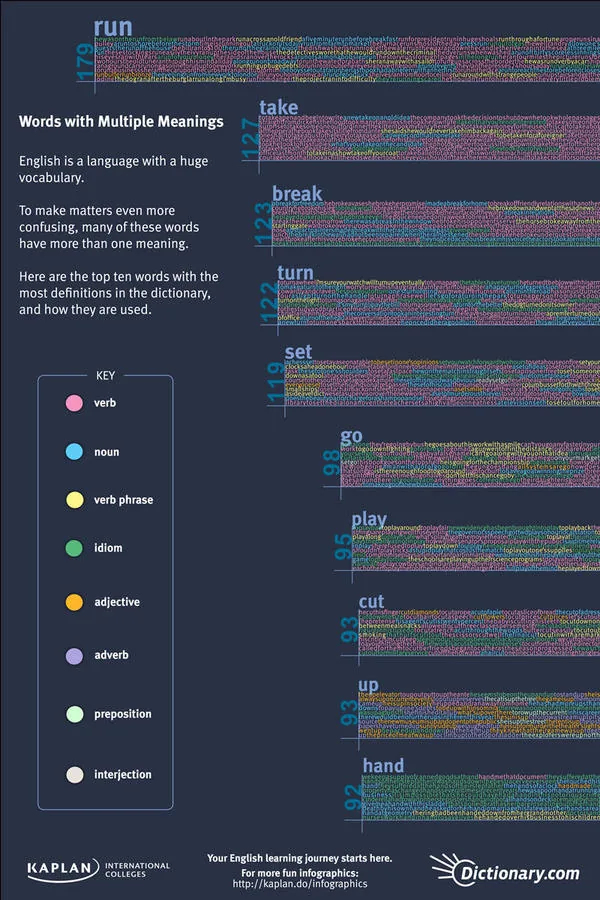
Do you know what “mean” means here? “Mean words” means unkind words — milder than swearing. Like a child scolded by a parent might say, “Dad said some mean words to me.” “Mean value” is the mathematical average — commonly used. “Mean house” means a humble dwelling. In the dictionary, “mean” has over a dozen meanings. Of course, “mean” isn’t the word with the most meanings — that’s “run,” with 179. Here’s a chart of the top 10 multi-meaning words. See? English is also profound. Original article here. Of course, you probably don’t need to master all 179 meanings.
Two more memorable examples:
One day, a colleague brought a cake to share. A guy took a bite and exclaimed, “It’s off!” I was dumbfounded. What? After listening for a while, I realised he meant the cake had gone bad. “Off” is the simplest word, but I didn’t know it could mean “spoiled.” There are many similar examples: “power is out” (power outage), “WiFi is down” (no internet). Very simple usages, but if you never hear someone say them, you won’t use them. Of course, you could express the same thing more complexly — like instead of “power outage” in Chinese, you could say “electricity supply has been terminated” — but who uses complicated expressions when simple ones exist?
Another example: I wanted to buy a fruit tree at the supermarket. The saplings were so tiny — when would they ever bear fruit? I wanted to ask the staff how long it takes for them to fruit. Then I realised I didn’t know the verb for “to bear fruit” in English. I got stuck. But I did know how to say “to give birth” — so I improvised: “It will bear fruits.” At least they understood. They answered: “It will fruit after 2 years.” It dawned on me — “fruit” can be a verb! That’s exactly “to bear fruit” in English. I only knew it as a noun. There are many such cases. Qian encountered one too: he said “squeeze the cows for milk” — vivid and descriptive, possibly correct but not good. The right word is “milk” as a verb: “milk the cows.”
Later, I learned a trick from Qian: if you don’t know the verb, just use “do” or “make” — the universal stand-ins. For example, “do fruits,” “do milk.” Like the Chinese word “弄” (nòng) — “go to the bank to nòng some money,” “at work nòng code,” “nòng milk from cows,” “when will the tree nòng fruits.” Works fine with minimal ambiguity.
Simple Words in Combinations
When Qian first started school, the teacher gave him an Essential Spell Words List, saying that mastering and applying these words would cover 75% of daily communication. I glanced at it — it seemed like the vocabulary of a child who’d been learning English for a year. I didn’t believe it. No way it covers that much. I’d still have found a 25% coverage hard to swallow. But over this past year, chatting with Kiwis, I’ve found their daily vocabulary really is the simplest words — nothing fancy.
This is the opposite of what I was taught. When I was doing my PhD and writing papers, I was told to pick “high-class” vocabulary. Minimise CET-4 and CET-6 words. Spend ages agonising over word choice. Of course, that’s probably the requirement for written language — like writing reports for Chinese leaders requires grand, parallel structures. But it’s not conducive to spoken communication. When I started working, colleagues said I often spoke like I was writing.
I later discovered that phrasal verbs (or colloquial expressions) can replace many complex words. A few examples — several of which I learned from Qian:
- absent (stand someone up) → “stand me up”
- interrupt (cut in line or while driving) → “cut me in”
- conclude (finish work) → “call it a day”
- reduce (scale down) → “run down”
- exhaust (use up) → “run out”
- disseminate (hand out) → “hand out”
- propose (come up with) → “come up with”
- synchronised (on the same page) → “on the same page”
All from the 200 simplest words on their Essential Spell Words List — infinite variety through different contexts and combinations.
Remembering New Words Through Association
Finally, although I think memorising vocabulary is low priority, some new words are unavoidable. For instance, this year at the family doctor, I learned all the words for fever, nausea, vomiting, runny nose, coughing, choking, and rashes. So how to remember new words? My memory isn’t what it used to be — clearly I can’t rely on rote memorisation like when I was young. I need mnemonics.
Again, Google Search is a godsend. Too bad it’s not available in China, and Baidu doesn’t support this. I don’t know if there’s a similar dictionary in China. Just type “define + word” in the search bar, and you’ll get a detailed definition, word etymology, and historical word frequency. These two things are very important. We’ll discuss word frequency later. Etymology is extremely useful for aiding memory.
We know that many European languages derive from Latin. Though no country speaks Latin today, it’s still a living language — NZ high schools offer Latin as an elective, similar to Classical Chinese for us. So the differences between these languages might not be that great — like the difference between Mandarin and Cantonese. Plus, Europe is small — about the size of China. Languages influence each other across countries. My European colleagues can all speak a bit of other European languages, just like Chinese can speak a few words of various Chinese dialects. Knowing the history of words is fascinating and makes them easier to remember.
Here are a few examples:
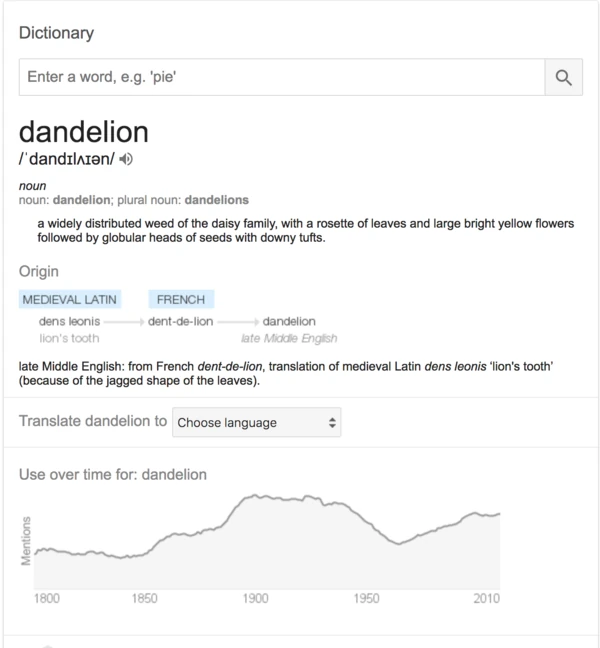
Dandelion — I couldn’t remember this word for ages. Then I happened to check its etymology: it means “lion’s tooth.” Probably named after its shape — like our Chinese “dog’s tail grass.” Dandelion would be “lion’s tooth grass.” How did it come about? First Middle Latin, then French: “dent-de-lion.” “Dent” is tooth — same root as “dentist.” “De” is French for “of.” “Lion” is unchanged from English. So “dent-de-lion” became “dan-de-lion” — the final form. Obvious once you know it.
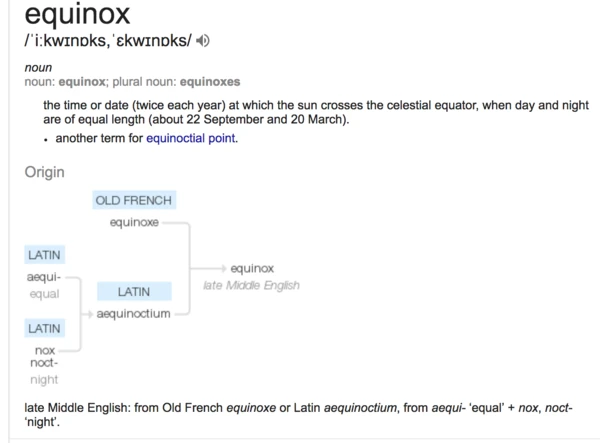
Second example: equinox (spring/autumnal equinox) — I also couldn’t remember this for the longest time. Etymology revealed it’s from Latin for “equal night” — meaning day and night are equal. The “equi” reminds you of “equation.” “Nox” isn’t quite “night,” but at least they share the first letter — easy to associate.
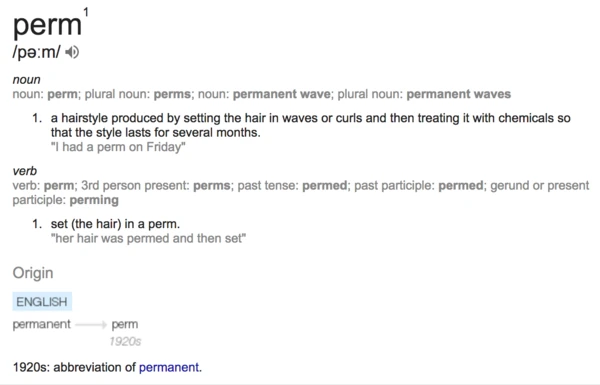
Last one: perm (hair perm) — I learned this from a movie, but with my failing memory, I couldn’t retain it. Etymology: it’s short for “permanent.” Won’t forget it now.
China might have similar root-based or affix-based memory methods, but I don’t know much about them, so I won’t comment. But I think etymology might be broader than word roots. Knowing a word’s origin means you not only know what it means but also why — the story behind it. Like many Chinese idioms: “脍炙人口” (lit. “minced meat and roasted meat are popular”) — what is “脍,” what is “炙,” and why is it about popularity? There’s a story behind it. You might think I’m crazy — memorising a word by learning its backstory. After all, many native speakers don’t know these origins. If you had a photographic memory, you wouldn’t need to. But this is just a memory aid.
Afterword
Not finished — leaving this as a placeholder. This article mainly covered vocabulary and expression. To communicate better, vocabulary is just one aspect — it only helps you describe something or express your views more accurately. But to be understood, you also need another thing: speaking. Because even if your vocabulary is large enough and your descriptions accurate, if your pronunciation is off and people can’t understand you, it’s useless. When I first arrived, colleagues couldn’t even understand my “seven” — I had to write “7” on paper. Very disheartening. So a simple pronunciation fix can dramatically improve communication. Additionally, to understand others, listening is also important. For most Chinese, speaking and listening are the weakest areas. I’ll save those topics for next time.