First Impressions of New Zealand #2: Daily Life
This is the second post in the series. Previous articles are here:
- First Impressions of New Zealand #1: Nature
- First Impressions of New Zealand #2: Daily Life
- First Impressions of New Zealand #3: Local Customs
First time using the tip function, and I received over 180 RMB. Totally unexpected. Thank you all!

Continuing from the last post, let me talk about daily life in New Zealand — clothing, food, housing, and transport. All currency has been converted to RMB. 1 NZD is roughly 5 RMB.
Clothing
I have to say, New Zealand is the least fashionable developed country I’ve ever seen, bar none. It’s a former British colony that recognises Elizabeth II as its head of state, yet it doesn’t learn a thing from the British royal family’s dressing style. Americans dress casually enough — Zuckerberg, China’s favourite son-in-law, gets criticised for wearing T-shirts every day. Compared to New Zealand, Americans actually dress quite presentably. The American middle class I’ve met generally have some concept of brands.
New Zealand? Regardless of who you are, the clothes people wear would be considered street-stall or Taobao-grade by Chinese standards. You almost never see anyone wearing clothes with familiar logos — it’s all no-name brands. I brought a few shirts from China — Ralph Lauren, Brooks Brothers — and found that nobody wears them here. Wearing them marks you as a newcomer, so I’ve stopped. My parents used to tell me I didn’t care enough about my appearance and dressed too shabbily. Here, I’m quite happy.
Don’t even think about buying big brands — their clothes, bags, and so on are basically unavailable. The only place I’ve seen brand-name clothing and bags is on Queen Street, the busiest street in central Auckland. Half the staff there are Chinese, and the windows advertise “UnionPay, Alipay, WeChat Pay welcome.” Nowhere else. So if you’re visiting New Zealand with the idea of “shopping spree,” forget it. Hong Kong, the US, Europe, and Japan are more suitable. New Zealand is for experiencing pure nature.
And you think that’s it? Not even close. Many New Zealanders don’t wear shoes. This is definitely a Kiwi special — straight out of Africa. It started when I was dropping Qian off at school and noticed lots of kids playing and attending class barefoot. Kids, fine. But then I saw plenty of adults walking barefoot on the street too. Even more wear flip-flops, and oddly enough, they’re all thongs — made in China, one dollar a pair, buy as you go, toss when worn out.

During our immigrant orientation class, the teacher said that to integrate into society, rule number one is: dress as informally as possible. Later, before a job interview, I asked what I should prepare. The reply: nothing. Just don’t dress too formally. I still wore a shirt, dress pants, and leather shoes (no tie). When I got there, the three people interviewing me were wearing: shorts, a collarless T-shirt, and an oversized hoodie. If their behaviour and speech hadn’t been so refined, I’d have thought I walked into a fake university with fake professors.
Food
Food is another topic worth complaining about. I recently saw a survey saying Chinese tourists to New Zealand are satisfied with everything except the food. That’s why a wealthy Chinese businessman recently announced plans to invest 100 million in an Auckland restaurant to solve Chinese tourists’ dining problems. It made the news, and everyone celebrated.
What do ordinary Kiwis eat daily? From my observation, they’re incredibly casual about meals. In China, even the most casual lunch involves at least two dishes from the canteen. What do New Zealanders eat for lunch? Some have a few walnuts. Some eat a banana. Some just munch on raw lettuce leaves. Having a sandwich or a pie is considered a fancy lunch.
Qian has to bring his own lunch to school. At first, we packed Chinese food — fried rice with stir-fry. Then Qian said other kids would envy him and ask for some. The teacher also said Chinese food was too fragrant and couldn’t be brought anymore. Now we basically give him bread with chocolate spread, plus some fried chicken or fish pieces prepared the night before. Qian says kids still envy his fried chicken. When I asked what his classmates eat, he said just plain bread slices. Incidentally, New Zealand bread is the cheapest I’ve seen globally — one NZ dollar gets you a huge bag that lasts a family a week. I wonder if there’s a government subsidy. Many people can’t finish it and just throw it to the birds.
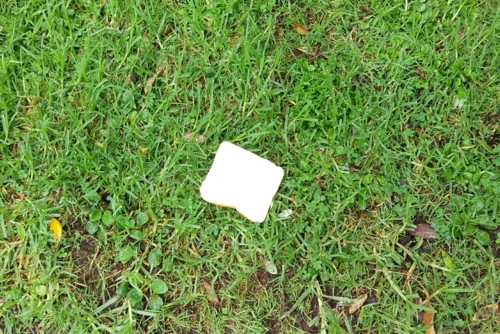
As for cheap food, there’s a joke online: British restaurants serve three dishes — chips, fish, and chips with fish. President Xi even tried fish and chips during his UK visit. As a former colony, this culinary tradition is perfectly inherited. The streets are full of fish and chip shops, and they’re super cheap. The portion in the photo costs about 25 RMB — basically the cheapest food you can buy. No wonder New Zealand has the highest obesity rate in the world.

Another popular item alongside fries is kumara (sweet potato) fries, which aren’t common in China. Kiwis call sweet potato “kumara,” not “sweet potato.” Kumara is a Māori word. How did the Māori have a crop native to the Americas? Everywhere else, sweet potatoes were brought from the Americas after Columbus. But New Zealand’s sweet potatoes were brought back by the seafaring Māori, who paddled canoes all the way to South America before Columbus and brought them home. Pretty amazing.
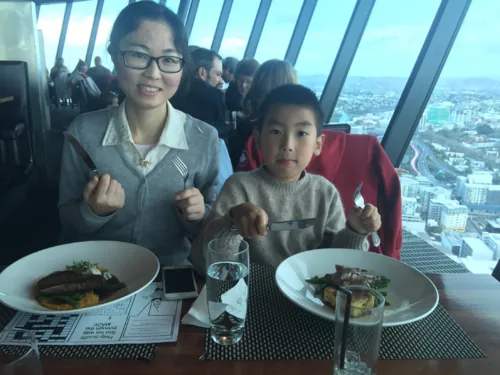
That’s the low end. As for high-end dining — honestly, I’m still not sure this country actually has any. A few times I wanted to take the family out to celebrate, I searched online for upscale restaurants and found nothing very expensive. In China, expensive restaurants can be ridiculously costly. For Qian’s mom’s birthday, we went to the revolving restaurant in the Sky Tower, the tallest building in the Southern Hemisphere. The service, food, and view were all excellent. It cost us about 800 RMB total. We concluded that spending 1,000 RMB on one meal for the family is mission impossible, unless you go to a Chinese restaurant and order 20 dishes.
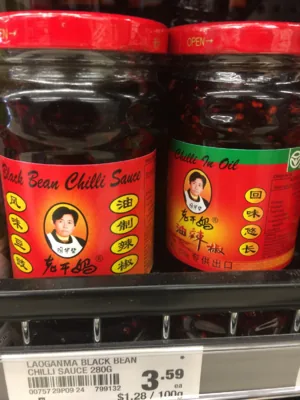
Auckland has a large Chinese population and plenty of Chinese supermarkets where you can buy Chinese vegetables. But okra costs over 200 RMB per jin — absurdly expensive, luxury-only. Lao Gan Ma, the national goddess of chilli sauce, is also available at about double the Chinese price, which isn’t too crazy. It says “export only” on the label, but I didn’t notice any difference.
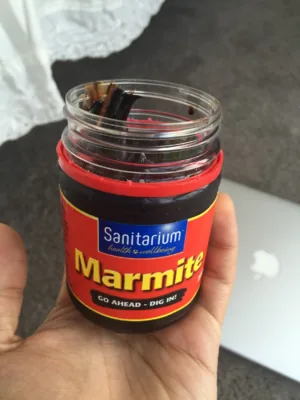
Speaking of condiments, let me introduce you to New Zealand’s national dark condiment: Marmite. It’s said to only exist in New Zealand and neighbouring Australia (Australia’s version has a different name). It looks like chocolate spread but tastes a bit like fermented tofu, but not quite. People either love it or hate it. There are hilarious videos online of people tricking Americans into thinking it’s chocolate spread. Many Kiwis just eat it on bread. Apparently, a few years ago, the Christchurch earthquake damaged the factory, causing the remaining stock to be scalped for hundreds of dollars a jar.
I also wanted to share some fruits and vegetables you won’t see in China, but both of those topics could fill another article.
Housing
New Zealand has few people and plenty of land, so housing is a major advantage. Let’s split this into residential and hotels.
As the country’s largest city, Auckland has very few high-rise buildings. The ones I’ve found are mostly for elderly retirees who live close together for mutual care. Ordinary homes are almost all standalone houses. To put it nicely, they’re villas. To put it bluntly, they’re village houses. Houses are spaced far apart — often a 100-square-metre home sits on 800–1,000 square metres of land. That’s why Auckland developers love buying a house, demolishing it, and building two houses on the same plot — one in front, one behind. When I told them their Chinese counterparts are mostly tearing down low-rises to build high-rises, they admitted they can’t compete. The evolution of urban housing: detached houses → semi-detached → townhouses → low-rise apartments → high-rise apartments. New Zealand is at stage one; we’re at stage five.
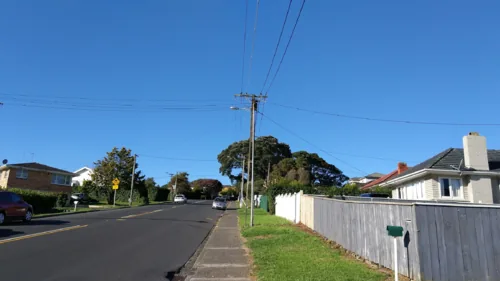
Property prices: Auckland is expensive, everywhere else is a bargain compared to Beijing, Shanghai, or Guangzhou. A typical single-storey 3-bedroom house in Auckland costs around 4 million RMB; a two-storey 6-bedroom costs about 6 million. New or old, everything goes to auction. Chinese buyers dominate every property auction. Locals even write articles about “how to buy a house without Chinese competition.” Even though the down payment is only 10–20%, many Kiwis live paycheck to paycheck, so it’s still a heavy burden. The market seems to be peaking. News reports say Auckland prices haven’t risen in a year and have even dropped slightly. I wonder if the government and banks are worried. Rumour has it that former Prime Minister John Key’s sudden resignation last year was partly due to public anger over runaway property prices.
For tourists, New Zealand generally doesn’t have the star-rated or budget hotel chains that offer all-in-one accommodation and dining. I’ve only found Hilton, Langham, and similar global brands in central Auckland. Outside of Auckland, every time we’ve travelled, we’ve stayed in small motels. A small motel might have just a few rooms, and you need to bring or cook your own food. Self-drive tourists should note this. But you often meet all kinds of travellers and owners, which has its own charm.
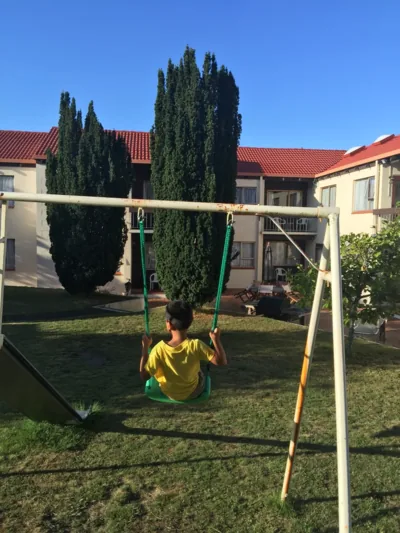
For example, the motel in the photo was on a remote lakeside. We booked online and arrived to find it was run by Chinese people. The owner was very welcoming and spoke Mandarin. He said Chinese people all flock to big cities, and in that small lakeside town, he hadn’t seen a fellow Chinese in months.
Transport
Last but not least, transport. Let’s split it into public transport and private cars.
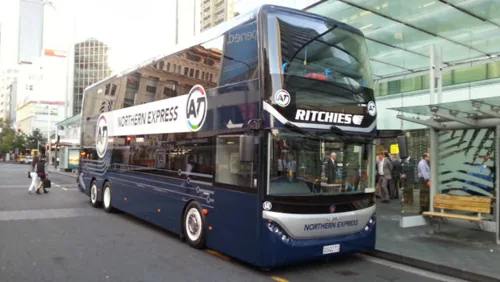
Compared to China, New Zealand’s public transport is practically in the Stone Age. The entire country has not a single metro line — not even North Korea has that distinction. The train from Auckland to Wellington, the capital, covers 600 km. A high-speed train in China would do that in about 2 hours, but New Zealand’s train takes over 10 hours. They even make excuses, claiming it’s the world’s most scenic railway and they deliberately go slow so passengers can enjoy the views. The most absurd is the bus system. With so few people, they still imported double-decker buses from the UK, their colonial master. Hong Kong, another former colony, also has double-deckers, but Hong Kong has enough people to fill them. In Auckland, you often have an entire double-decker to yourself. Because ridership is low, buses are quite expensive. And they run infrequently — often once every half hour.
Now, private cars. New Zealand has no auto industry of its own. Essentially, the entire country is Japan’s used-car processing facility. About 80% of cars on the road are Japanese used imports — Toyota, Nissan, etc. Occasionally you see a BMW or Mercedes, and they’re often driven by fellow Chinese. I discussed this with a classmate working in Japan. Why does New Zealand become Japan’s used-car dumping ground? He found it hard to understand too. Indonesia or other developing countries, sure. But New Zealand is a developed country. I read in a newspaper that New Zealand has the fastest new-car depreciation in the world. Buy a new car and you’d better show off to colleagues and friends immediately, because it’ll depreciate fast. So hardly anyone buys new. Also, driving is on the left, so Japanese used cars can be driven straight off the boat. Because there are so many Japanese used cars, a term has emerged: “New Zealand first-hand car” — meaning a used car freshly imported from Japan that hasn’t been sold in New Zealand yet.
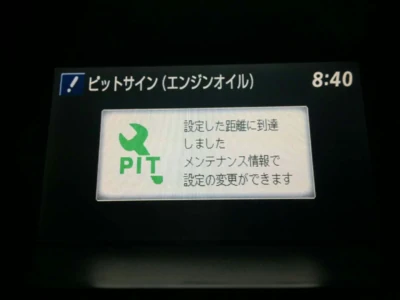
I followed the local custom and bought an 8-year-old “New Zealand first-hand” Nissan Teana, 2.5-litre, for 9,000 NZD — just over 40,000 RMB. We’d budgeted 50,000, not expecting to get such a good car. Qian’s mom drives it to work, and many people say it’s a bit luxurious. Every time you start the engine, it says something in Japanese. The onboard computer is entirely in Japanese, the GPS only has Japanese maps, the clock is stuck on Japan time. We even found a 500-yen coin in the cupholder.
People drive very conscientiously and follow the rules — nothing much to say there. Repairs are super expensive, again because there are so few people and labour is scarce. That might also be why everyone drives so carefully. I’ve had two repairs. First time, a screw fell off the undercarriage — 750 RMB, at an Indian-owned shop. Second time, the rear bumper was rear-ended and needed repainting — 2,100 RMB, at a Chinese shop. I also had a tyre patched once, at a white-owned shop — 180 RMB.
Finally, driver’s licenses. Getting a Chinese license is hard; getting a New Zealand license is also hard. China’s is hard because of the many subjects. New Zealand’s is hard because of the long cycle. First, you pass a theory test plus a one-hour practical test to get a restricted license. With a restricted license, you need a full-licensed driver with at least two years’ experience in the passenger seat. After 3 months to a year, you can apply for the full license test — another half-hour practical test. Many people fail the practical multiple times, especially the first one-hour test. It’s very strict — two minor errors or one major error in an hour and you fail. Qian’s mom and I both passed on our first try. Very lucky.
The first two articles have been mostly informative and objective. Next, I plan to write about local customs and people, which will include many of my own subjective impressions. It might be controversial. Let me think about whether to write it.