First Impressions of New Zealand #1: Nature
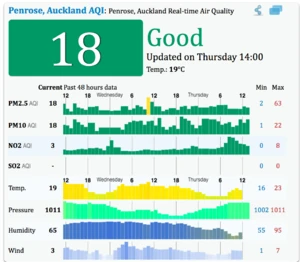
Because Qian had to go to school, we couldn’t travel far and only toured around Auckland. But the country isn’t large, so the Auckland area covers about a quarter of the country. The first impression of this country is its incredible environment — the term “100% Pure New Zealand” is frequently used in media. Everywhere you look there’s lush green grass and blue skies. Peter Jackson, the local New Zealand director, filmed The Lord of the Rings and The Hobbit here in Middle-earth. I checked the AQI — Auckland is probably the most polluted area in the country, and it’s consistently around 10-20. Other places are often in single digits.
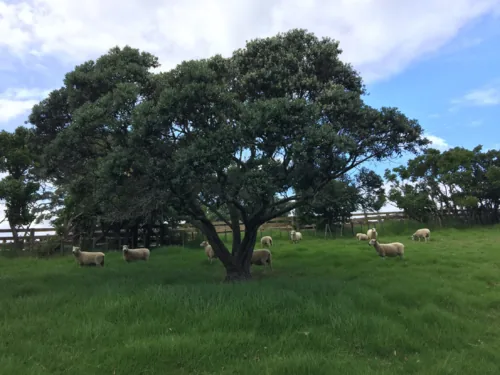
Auckland is the largest city, home to a third of the country’s 4 million people. But even so, only about one square kilometre of the city centre feels like a modern metropolis. Everywhere else is a mix of urban and rural. Outside of Auckland, the entire country is basically a pasture. Saying New Zealand is a “big countryside” isn’t quite accurate, because unlike the US or Canada with vast cornfields, you’ll hardly see any farmland here. Almost all grain is imported — a small country with no enemies, and nobody worries that other countries won’t sell you food. New Zealand is more accurately a giant ranch. Hillsides are covered with pastures full of sheep and cattle — a country with more sheep than people lives up to its reputation. So lamb and beef in supermarkets aren’t expensive (compared to China). Milk is even cheaper. Three litres of fresh milk costs about 15 RMB. Cheaper than soy milk, cheaper than juice. About the same price as bottled water. Many people drink milk when they’re thirsty. Unfortunately, I’m lactose intolerant, so I can’t enjoy it. But Qian loves it.
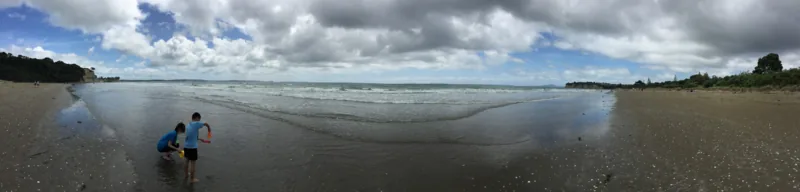
Since the country is a long, narrow island, you can drive half an hour from almost anywhere to reach the coast and enjoy sunshine and beaches. And with so few people, a family often has an entire beach to themselves. Auckland is called the City of Sails. Many families own boats and tow them to the sea on weekends. You don’t need a special licence to drive a boat — just money. I looked into it: a boat costs around 100,000–200,000 RMB. I wonder if boats, like cars, have luxury brands like Porsche and cheap ones like Chery, and whether you can race them. But marina berths are very expensive. Many people can’t afford one, so they just leave their boats in the backyard, exposed to the elements.
At night, the sky is filled with stars. Qian said he’d been singing “Twinkle Twinkle Little Star” since childhood, but only after arriving in New Zealand did he truly see a sky full of stars. Of course, the Southern Hemisphere has more stars than the Northern Hemisphere anyway, and the constellations are reversed. Apparently there’s a small town that turns off all its lights at night, making it a paradise for astrophotographers worldwide.
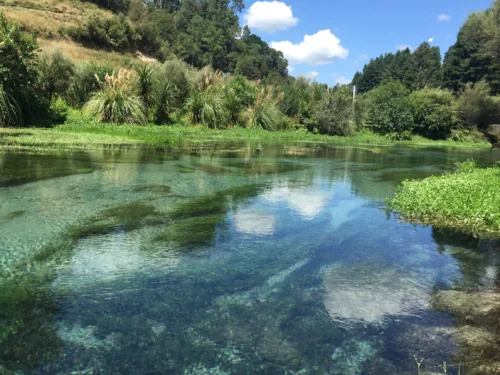
We drove to a place called Putaruru. Incidentally, many place names in New Zealand are in Māori. They’re hard to remember but easy to read — just pronounce them like Chinese pinyin and you’ll be fine. Yet another piece of “evidence” that the Māori descended from the Chinese. Putaruru has a spring called the Blue Spring, said to be the purest in the world. The water is crystal clear. Chinese jokingly call it “New Zealand’s Jiuzhaigou.” The description says 80% of the country’s bottled water is filled here. There’s an ad for this water on the Middle Ring Road in Shanghai, called “New Spring Blue,” marketed as high-end purified water for infants. But when I visited, I saw people swimming in the spring, so that premium water might actually be bathwater. On that note: any New Zealand product with a brand starting with “NZ,” except for NZMP milk, is almost certainly run by Chinese people in New Zealand. Choose carefully.
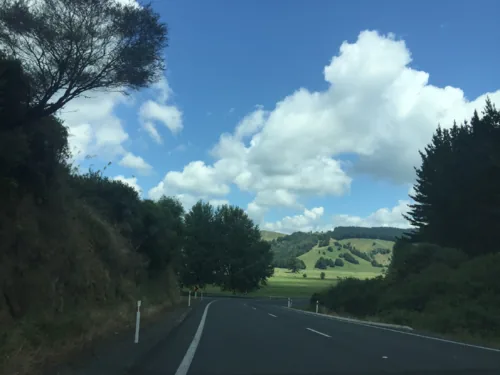
New Zealand’s highways are toll-free, but I think it’s because the roads are too poor for them to charge. Outside Auckland, national highways are mostly single-lane. The lanes are narrower than in China, and there are no barriers between oncoming traffic. It’s pretty scary when a car comes at you at over 100 km/h. The roads aren’t straight either — constant ups and downs with sharp curves, and signs telling you to slow down to a certain speed to navigate them safely. But then again, there’s no real need to build better roads — you can drive for half an hour without seeing another car.
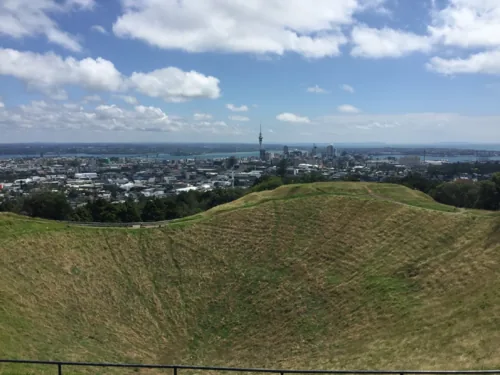
New Zealand sits on a plate boundary, so seismic activity is intense. Last year’s earthquake was no surprise. A few years ago, Christchurch in the South Island was completely destroyed by an earthquake. Even Auckland, the largest city, has a massive volcanic crater right in the city centre. You can’t tell from the picture, but seeing it in person is quite frightening — it’s so deep you’d never climb out. And it’s right in the city. If it erupts again, the whole country is finished.
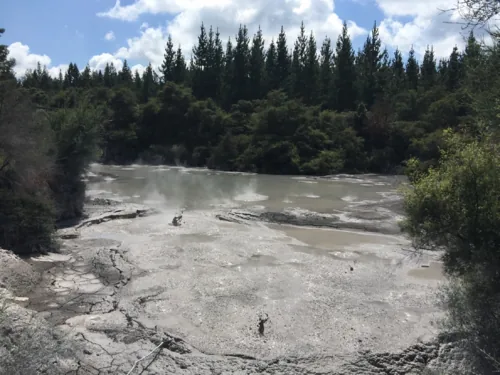
We went to a place called Waiotapu — another Māori name. The air there reeks of rotten eggs. The air quality probably isn’t great. The area is full of geothermal springs, and there’s a geyser that erupts once a day. Steam rises from the roadside, making you feel like a volcano could erupt any minute. Pools of mud bubble away. Signs warn that the mud is extremely hot and falling in would turn you into a skeleton instantly.
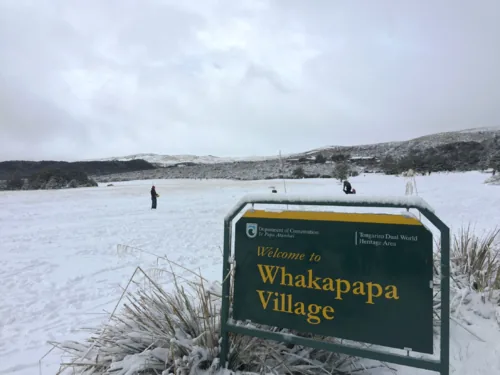
The last photo was taken last summer during the school holidays. The seasons are reversed between hemispheres. When it’s winter in China, it’s summer here. The climate is Mediterranean — not cold in winter, not hot in summer. Students wear shorts in winter, and you need a blanket to sleep in summer. It rarely snows. The only ski field in the country is Tongariro National Park in the middle of the North Island, where the altitude allows for snow accumulation. But when we went, the mountain was snowed in, so we just had a snowball fight and headed back.
All of the above is the good stuff. The downside is the UV. New Zealand sits under the ozone hole in the Southern Hemisphere, with direct UV exposure that can be brutal. Back in China, I checked the AQI every day to see if it was off the charts. Here in New Zealand, I check the UVI — the UV index — every day. You basically have to put on sunscreen before going out. And sunscreens here come in bulk — massive bottles like family-size shampoo — none of the small tubes you see in China. Without it, mild cases leave your skin sore for three days; severe cases leave you blistered and peeling. China’s air pollution is bad — I don’t know if China has the highest lung cancer rate in the world, but New Zealand unquestionably has the highest skin cancer rate. One in 17 people will get skin cancer. That’s pretty scary.
Of course, a good natural environment was expected before coming to New Zealand. What truly surprised me was how clean everything is. Nature provides the beauty, but keeping it clean takes people. Everywhere there are parks or reserves. Every park and beach I’ve visited is spotless, with no dedicated cleaners in sight. Everyone takes their rubbish with them. That’s definitely something we can learn from.
All in all, as a tourist, I think New Zealand is well worth a visit. You can experience the purity of nature. As a Chinese person, you’ll be blown away (though China can also blow New Zealanders’ minds — a different kind of shock, to be discussed later). I’ve only explored the area around Auckland and I’m already in awe. I hear the South Island’s scenery is many times better, but I haven’t been yet. Even Americans or Europeans would be stunned by the natural purity here. My boss is a pure-bred American who came to New Zealand decades ago on sabbatical, was blown away, and never went back. Premier Li visited last month and declared 2019 the China-New Zealand Tourism Year. I hope everyone gets a chance to visit New Zealand. I’ve traveled quite a bit around the world, and if I had to recommend two destinations, they’d be Taiwan and New Zealand.
Next, I’d like to write about daily life — clothing, food, housing, and transport — and then about work, history, and local customs. Let me know what you’re interested in. Feel free to leave comments.