Buying a House in New Zealand #2
An auction is also called an unconditional offer. This means that if you win, you must buy the house no matter what problems it has, and regardless of whether the bank will give you a loan. So auctions aren’t cost-free for either buyer or seller. If a buyer is serious about a house, they’ll usually hire someone to do a building inspection before the auction. That costs a few hundred dollars. If a seller puts a house up for auction and it fails, they still have to pay the auction fee. The final price is essentially what the buyer pays — the government doesn’t take a cut. No stamp duty, no deed tax, no land tax, no handling fees, no registration fees, no survey fees, no appraisal fees… The auction fee and agent commission are paid by the seller, but of course, the wool comes from the sheep.
Before the auction, we set a rough budget. Everyone was saying the market was cold with few bidders, so we didn’t expect much competition. When we arrived on auction day, there were 30 to 50 people. Half were Chinese. That immediately rattled me. As the old saying goes: whether it’s grabbing iPhones, baby formula, or houses, I’m confident I can beat the Westerners, but I’m not confident I can beat my fellow countrymen.
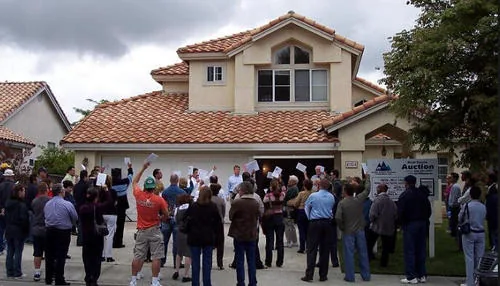
Before the auction began, the auctioneer introduced the basics of the house. At that point, all the Chinese people clustered together on one side, and everyone else stood on the other. This scene suddenly made me feel like my three-year-old worldview was correct: there are only two countries in the world — China and everyone else.
As if designed specifically for Chinese buyers, you don’t need to understand English at the auction — just recognise numbers. The auctioneer starts bidding at a price far below market value, essentially a warm-up — if you win at that price, you’ve already made money flipping it. Then it rises in increments of 10,000. If you think the price is acceptable, raise your hand. If not, don’t. The last person with their hand up gets the house.
When the auction officially started, nobody bid. It looked like it would fail. Then one of the older ladies in the non-Chinese group bravely called out a price. The Chinese side erupted — people were shouting, but nobody bid. I later realised they were just there to watch the show — or maybe to snatch a bargain. We bravely made a bid. Now the pressure was on the non-Chinese side. That same older lady outbid us. Back and forth a few times. Only us on the Chinese side and the older lady on the other side were bidding. Each time the older lady bid, the Chinese crowd got indignant: “Don’t let her get away with it!” “Fight them!” Every time we outbid her, the crowd burst into applause…
After a few rounds, the older lady reached our pre-set budget. We decided not to continue. The auctioneer noticed. He stopped raising by 10,000 and asked, “How about another 5,000?” We held firm. After we added the 5,000, we closed our folder and prepared to leave. Then the older lady stopped bidding. The auctioneer shouted, “Don’t go, come back — the house is yours! Come sign the contract!”
My wife has always suspected the older lady was a shill hired by the seller. At her age, she should be in a retirement apartment. Even if she wasn’t, she’s unlikely to want a two-storey house. Most Auckland houses are single-storey, which is more elderly-friendly. A house with bedrooms upstairs would be very inconvenient for her daily life.
If she wasn’t a shill and genuinely wanted the house, she probably felt that the Chinese had taken her opportunity. The media constantly hypes how Chinese buyers drive up prices — “limited English, unlimited budget.” I just want to be a good citizen, and I really don’t want to add fuel to those claims.
On a side note: during the election, one party used “Chinese driving up house prices” as a campaign topic, claiming Chinese had bought 40% of Auckland homes. But NZ doesn’t record buyer nationality when selling property. How do they know which buyers are Chinese? Two methods: first, check if the buyer’s surname is monosyllabic; second, if it’s a couple, check if they have the same surname. Monosyllabic surname + different surnames for spouses = Chinese. Honestly, that’s pretty reliable. Though it would inflate the numbers. For example, the pure-Kiwi young guy next door is named Young — and he’d be counted as Chinese…
Settlement
After winning the auction, you pay 10% on the day and go about your business. But you’re far from moving in. You have to wait for the settlement date. The time between auction and settlement varies. In our case, the seller needed our money to buy their next house, so the settlement period was long — two months. During this time, you’d usually go through the formal loan process with the bank, buy insurance, furniture, appliances, etc. With Kiwi efficiency, getting broadband connected can take a month — no joke.
Unlike China, you need a lawyer for buying a house. All paperwork, including money transfers, goes through lawyers. The buyer and seller each have their own lawyer, and they don’t talk to each other about the house — the lawyers handle everything. Normally, lawyers charge by the hour — say $300 per hour. But because Chinese people generally distrust each other and fear the other side will deliberately drag things out to charge more, a fixed-fee system has developed: $1,000 per property transaction. But this is apparently just an oral agreement — I don’t know if it’s legally binding. The contract you sign with the lawyer is still an hourly contract. If something goes wrong with the house purchase and you need to sue, don’t expect the fixed-fee lawyer to go all out. Similarly, if you have a dispute with the lawyer, an ordinary person probably won’t get the better of them. We also chose a fixed-fee Chinese lawyer. We met her exactly once, just to sign — about 20 minutes. And then there was an extra 15% GST on the lawyer’s fee. I felt short-changed. If I ever have another chance, I’ll definitely go with a Western lawyer.
The settlement process roughly works like this: the seller’s lawyer calculates the final settlement price — usually the auction price plus any council rates already paid to the government. Subtract your 10% deposit. The seller’s lawyer tells the buyer’s lawyer the amount. The buyer’s lawyer tells the buyer. On settlement day, the bank transfers the loan to the buyer’s lawyer’s account. If it’s not enough, the buyer tops up with cash. Finally, the buyer’s lawyer transfers all the money to the seller’s lawyer, who pays the seller. Then you get the keys. Done.
New Zealand doesn’t actually have property certificates. You don’t need one for anything. There’s only a registration record at the local council. If you need a PDF of it, you can apply to the council yourself for a small fee. But I found my lawyer would charge a few hundred dollars to do it for you, claiming it was a “property certificate fee.” That’s a trap.
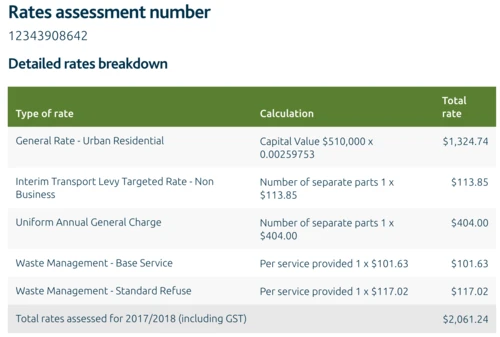
New Zealand also has no property tax. But every year, based on the government’s valuation of your property, you pay the local council a “Council Rate.” The detailed breakdown is available online — it basically goes toward rubbish collection. The government website has valuations for all properties — truly a “one property, one price” system. Updated every 3 years. Homeowners are conflicted when an update comes — they want the value to go up, but that means paying more rates.
Household Expenses
NZ houses are mostly built from local timber — unlike Chinese brick or concrete structures. Brick or stone houses are expensive and rare. Wooden houses leak air, aren’t well-insulated, aren’t soundproof, and leak easily. One good thing: they don’t block Wi-Fi.
In China, when you buy a house, the first thing is to renovate — just hire a renovation team, simple. Here, renovation is a huge hassle, mainly because labour is so expensive. Our house was built in the 1980s, but well-maintained. We didn’t plan major renovations — just repainting, recarpeting, and cleaning the moss off the roof.
At the paint store, I asked if they could recommend someone to paint. The staff said, “We all watch online videos and paint ourselves. Hiring someone will scare you with the price.” At the carpet store, they gave a quick quote — the installation cost was higher than the carpet itself. The only pleasant surprise: lamb is cheap, and so is wool carpet. The seller then told us the carpet had been replaced just a year ago — no need. We planned to hire someone to clean the moss, but people said it was the rainy season — the chemical would wash away. Wait until spring in September. So none of the three things got done.
How expensive is labour? A colleague was renovating her house. She said the renovation workers charged NZ$100 per hour, starting from when they leave their house. That’s $800 a day, $20,000 (100,000 RMB) for a month. And Kiwi renovation workers emphasise work-life balance — they don’t work hard, so they might not finish in a month. That means a renovation worker earns 2–3 times a university professor’s salary. No wonder the civil engineering lecturer I knew resigned to become a renovation worker.
Compared to China, water, electricity, gas, and internet are also behind. Because houses are so spread out, the worst thing is touching infrastructure — running a new water pipe or fibre line to your house can cost tens of thousands.
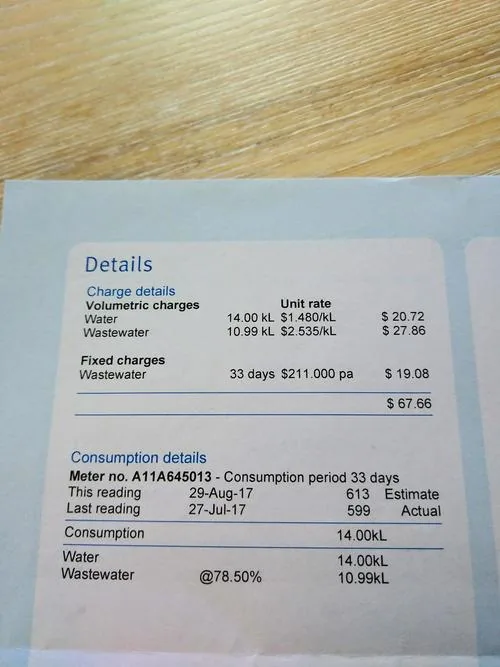
Water: outside Auckland, the rest of the country doesn’t pay for water. But in Auckland, the big city, water isn’t cheap. There’s a $20 monthly connection fee even if you use nothing. The truly absurd part is that wastewater charges are higher than water supply. There’s only one water company, a monopoly — just like China. But you can choose not to use tap water. Maybe the environment is so good that many NZ households have a large water tank on the roof to collect rainwater, which is usually sufficient. During a drought, you can call a water delivery company to fill the tank. Inconvenient, but when you consider that a water pipe connection costs tens of thousands, many people put up with it.
Electricity: many generation companies, many retail companies, but only one grid — state-owned. This state-owned company really delivers: all Auckland residents automatically become shareholders. Every year, the company pays dividends to shareholders, so each household gets a few hundred dollars in dividends. Turns out capitalism has some good ideas after all! As for retail electricity companies, thanks to smart meters, you can switch companies anytime. They offer all kinds of fancy services — just imagine Chinese telecom companies selling data plans: free data with top-ups, free data for loyal customers, free data for Taobao shopping, unlimited data on Friday nights…
Broadband: many providers, but unlimited data plans only started appearing in recent years with the popularity of streaming services like Netflix. The real problem is how slow it is to get connected. I contacted Vodafone, the largest provider, a month in advance. By settlement day, the modem still hadn’t arrived. I had to go to the store to pick it up. The odd thing: when paying your internet bill, you can choose “line insurance.” If the line is damaged, insurance covers the repair. Otherwise, if your line breaks and you’re unlucky enough that it’s on your property, prepare for a massive repair bill.
TV: same story — houses too spread out for cable. Every house has an antenna or satellite dish on the roof, like China 30 years ago. A few channels are free — just buy a decoder box from the supermarket for $200. Some channels, like sports, require payment. I only realised after moving abroad why Westerners go to bars to watch sports — it’s not about the atmosphere. Sports channels are too expensive, so it’s cheaper to buy a drink at the bar.
Gas: piped gas is rare in NZ. It’s still at the “carry your own gas bottle” stage. You can swap bottles at supermarkets and gas stations. On the other hand, Westerners rarely need open flames for cooking — they use electricity, and so do we. Not much to say.
You must insure your house. Wooden houses burn easily. If it burns down, the insurance company pays. But you decide how much to insure. Too little, and you won’t have enough to rebuild. Too much, and the premiums hurt.
Lawns need regular mowing, or neighbours will report you. If you’re lazy, hire a gardening company — another expense. Chinese people generally don’t have gardening skills, so many new Chinese homeowners’ first task is to dig up the lawn and plant vegetables, or pave it with concrete — permanent solution.
Rubbish collection is light-years behind China. Each household has two bins — one recycling, one landfill. At a fixed time each week, you drag the bins to the kerb for the council trucks. The problem: each household has a bin limit. If you exceed one bin in a week, you have to store the excess at home until next week. Many types of rubbish can’t go in the council bins — you must pay to dispose of them yourself. Fridges, computers, phones, washing machines — in China, you can sell them for cash. Here, you haul them to a special recycling centre and pay them to take it. Garden waste — weeds, leaves — also requires paying a specialised company to haul away. I really miss the days of unlimited dumping in China.
Littering fines are severe — including throwing household rubbish into public bins or other people’s bins. In China, we’re in the “don’t let rubbish hit the ground, Shanghai will be more beautiful” era. I’ve seen Chinese warning notices on public bins in several places: “No household rubbish.” Very eye-catching.
Incidentally, I’ve always thought China has the best waste recycling system in the world — not through sorting, but through manual labour. Whatever you throw away, if there’s anything recyclable, someone will pick it out and sort it. This reflects China’s abundant human resources. Many people call for waste sorting in China. If China ever sorts waste as meticulously as Japan, I wonder how many bottom-of-the-barrel waste pickers would go hungry.