Being an Extra in New Zealand - Part 1
- Watching pirated movies still cost money. As a middle school student in a small town in southeastern Shandong, one of my main pastimes was renting pirated movies from the local video store. Disney’s The Lion King and Toy Story were sweeping the globe, sparking a wave of Hollywood animated blockbusters. Even our tiny town’s video rental shop joined in. One random weekend, I somehow rented a tape labeled as Disney’s latest: Mulan. That was my first encounter with Disney’s 36th animated feature.
Maybe because the story was so well-known — schools required us to memorize it — the animation didn’t leave a huge impression on my childhood self. My only memory was the matchmaking scene where everyone was made up like Japanese geishas, and that talkative little dragon. Like most people, I didn’t understand why Disney, an American company, would adapt a Chinese hero story. Little did I know that 20 years later, I’d be on the other side of the planet participating in the live-action adaptation.
This series covers my experiences before and during the filming of Mulan in New Zealand. Even as just an extra, I learned a lot.
The Encounter
As CGI matured, putting real actors alongside animated characters became easier. Disney adapted classics like Cinderella, Beauty and the Beast, and Winnie the Pooh into live-action films, with great box office returns. Mulan was next.
I knew Mulan would be remade, but knew nothing else — until one morning at work. My Nordic colleague M, who served in the NZ Army Reserve, told us the Mulan crew was looking for hundreds of Chinese people within the NZ military. But there were barely 10 Chinese in the entire NZ military. They’d become desperate — Mongolians, Afghans, Turkmen, Iranians, Pakistanis — anyone would do. “Go now! You could be the prince dancing with a Disney princess!”
I initially dismissed it as a joke. Why would Hollywood film in New Zealand? A quick search revealed the director, Niki Caro, is a born-and-raised New Zealander and a University of Auckland alumnus. That explained everything. Kiwi directors are talented and inexplicably patriotic. Their specialty: taking Hollywood contracts and bringing the production home. The most famous example is Peter Jackson’s Lord of the Rings and The Hobbit trilogies. Single-handedly, he built New Zealand’s film industry from scratch to world-class, creating a tourism boom and earning the country the nickname “Middle-earth.” Many Hollywood blockbusters are actually directed by Kiwis — Marvel’s Thor, for instance. The government encourages this with policies to attract overseas filming and boost the economy. It’s similar to China taking iPhone, Nike, and Barbie manufacturing contracts — just in the film industry.
That evening, I told Qian. He got incredibly excited and insisted I participate. He’s loved Disney’s Marvel characters since childhood — Spider-Man, Iron Man. About 5 years ago for his birthday, I bought him some Disney stock as a gift, making him a shareholder in his favorite characters’ company. Ever since, he’s acted like a Disney owner, persuading friends to watch Disney movies and visit Disneyland. Having his dad star in a Disney film would feel like I was working for him.
But wanting to participate and being accepted were different things. My only on-screen experience was 30 years ago, when a local TV station covered our small town library’s opening. As an “innocent flower of the motherland” (elementary student), I appeared as background for 2 seconds behind the officials being interviewed. No other filming experience. Would the crew want me?
After much internal debate, I decided to play the sympathy card — like those talent shows that turn into misery competitions. I wrote a melodramatic self-recommendation letter: I’m not doing this for fame or money, just to fulfill my only child’s small wish, to be a good father…
To my surprise, the crew replied immediately: “We have an audition tomorrow at 8 AM. Wear sportswear. Come to the studio.”
I’d read a book called The Hero with a Thousand Faces. The author总结了 Eastern and Western hero stories’ patterns: ordinary life, then a call to adventure shatters the routine. Receiving that audition notice, I felt the same call. It was time to say goodbye to my 9-to-5.
The Audition
The next morning, I drove to Kumeu Film Studios, 30 km northwest of Auckland, arriving 20 minutes early. But getting off the car, I was confused. Was this the place? Nothing but farmland — sheep, cows, alpacas. Nothing like Shanghai’s Chendu or Hengdian Studios. People gradually arrived. I confirmed we were in the right place.
About 30 people auditioned — mostly Chinese, a few Southeast Asians. Chatting with them, I discovered Auckland is full of hidden talent. One guy, 190 cm tall, carried a massive sword and full martial arts gear, his hair flowing to his waist. He demonstrated a backflip on the spot, saying he’d trained since childhood as if waiting for this day. Another middle-aged man, ethereal-looking in tai chi attire with a horsetail whisk, sat meditating with eyes closed, muttering — clearly no ordinary person. A woman brought her son to audition. She couldn’t speak English but drove a Porsche Cayenne. I estimated her car was worth more than the other 50 cars in the lot combined. In New Zealand, where people treat cars like disposable bicycles (buying second-hand, using until they die), someone driving a Cayenne and willing to let their kid be an extra — maybe poverty limited my imagination.
At 8 AM sharp, the crew arrived. First thing: sign NDAs. Each person held their NDA and was photographed against a wall. Then they told us: this is a period piece set in ancient China 1000 years ago. Your role: soldiers. Martial arts or military experience preferred but not required — they couldn’t find enough people anyway. This wasn’t a pass/fail audition. They’d be grateful for anyone willing. Positions would be assigned based on ability. No physical contact in fight scenes — all simulated, perfectly safe. I relaxed. Why couldn’t they find 1000 Chinese in NZ? Probably because they weren’t advertising widely.
The audition was fun. We lined up in three rows and were taught boxing, staff techniques, sword techniques, and archery — all by copying the foreign stunt coordinator’s movements. Each routine had a dozen moves, much harder than the 8th set of广播体操. The morning was tiring. The chubby Singaporean kid next to me (who later played a drummer in the conscription scene) was sweating profusely despite the winter cold, stripping down to a vest. Now I only remember the boxing routine; the rest are long forgotten. Kind of funny: my first Chinese martial arts routine was taught by a foreigner, overseas.
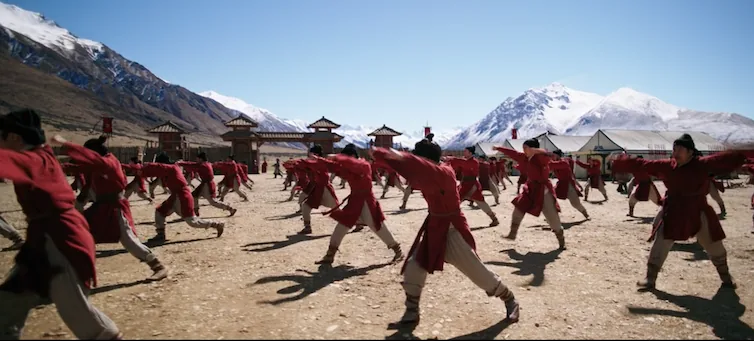
Figure 1. Learning boxing
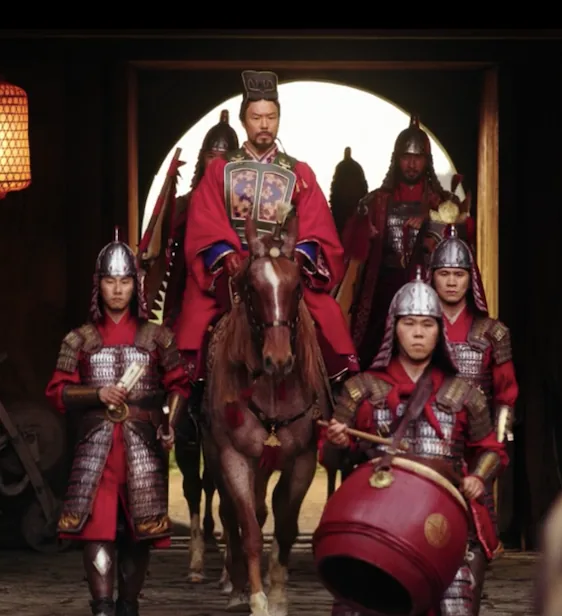
Figure 2. The drummer soldier
After the routines, we filled out forms: height, weight, clothing size, and available filming time. The crew required at least two months: one month of intensive training in Auckland, then six weeks of filming in the South Island. I couldn’t just disappear for two months — I had work and family. I told them honestly: I could spare at most two weeks.
Two weeks passed with no response. I assumed I was out. Then, just before training was to start, I couldn’t resist contacting the crew. As expected, soldier was out — not enough time. But they said: “We can’t use you as a soldier, but we need villagers. It’s only about 10 days of filming. Interested?” Just when I thought the extra之路 was hopeless, things took a turn.
Now that the film is out, I think it’s lucky I didn’t play a soldier. They’re all long shots, and they all dress the same. You’d never find yourself.